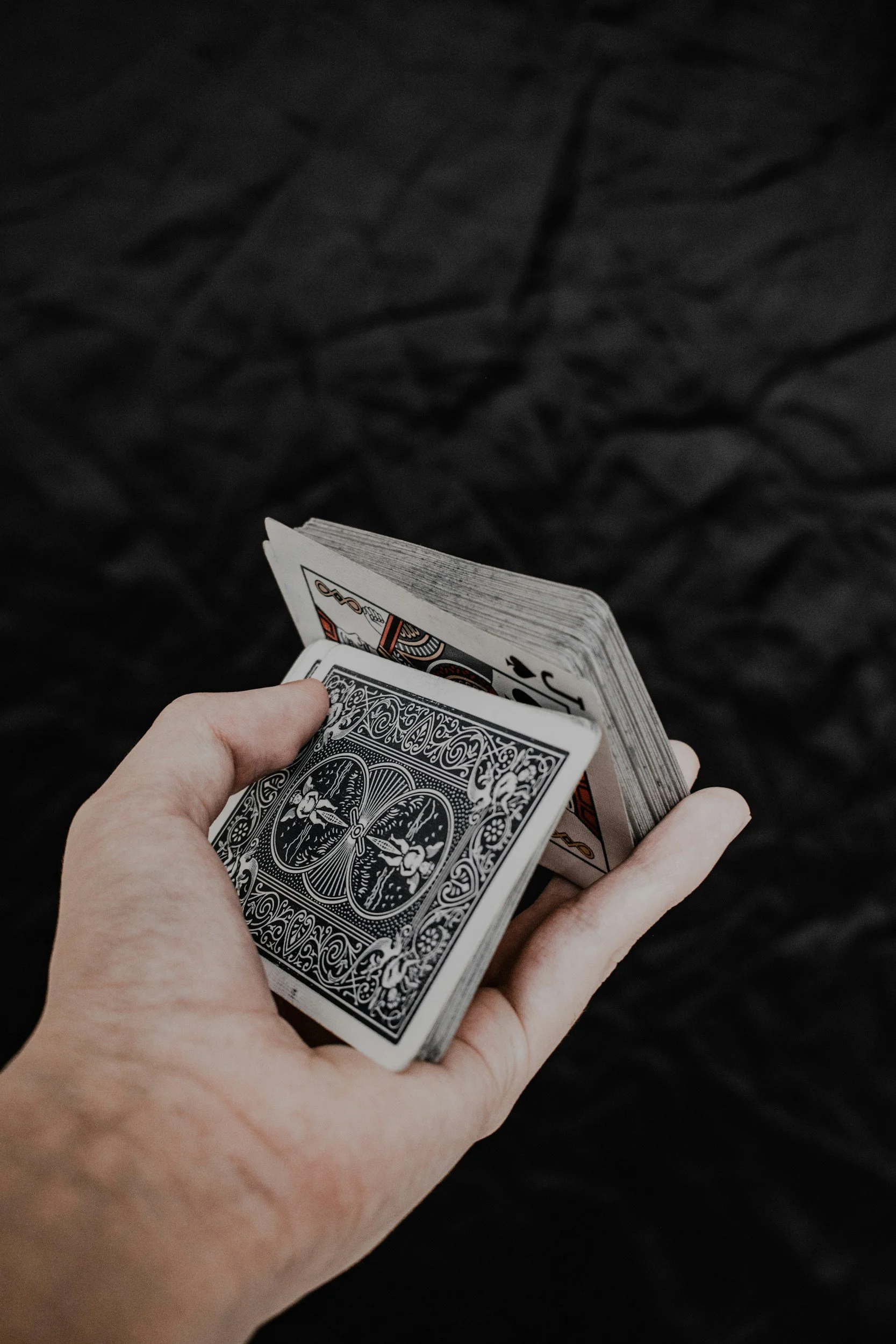
In fifteenth-century Italy, a new card game emerged among the aristocracy. It included four familiar suits: cups, coins, swords, and batons. Along with an additional set of illustrated cards depicting emperors, there were also religious figures, virtues, death itself, fortune, and divine judgment.
Today, we call these cards tarot. But the earliest players weren't consulting them to discover their futures or understand their relationships. They were just playing a card game with friends.
The cards reflected the world they lived in. Kings and emperors held earthly authority. Religious figures represented spiritual authority. Virtues like Justice, Temperance, and Fortitude expressed moral ideals. Fortune turned her wheel, reminding players of the instability of daily life played out because Death came for everyone. And beyond the uncertainties of earthly life stood the promise of divine judgment. To a fifteenth-century Italian, these images would have been recognizable figures of an ordered universe. Their meanings were embedded in both the cards and the culture itself. And they practiced this order through a game.
The cards weren't necessarily designed to explain that universe then. They simply represented it. And to understand why that matters, we need to visit a world several centuries older.
The World in the Cards
In the eighth century, a Christian theologian named St. John of Damascus wrote An Exact Exposition of the Orthodox Faith, a systematic account of Christian belief that drew upon centuries of Greek philosophy and theological thought. John lived in a world where understanding the natural universe and understanding its Creator were intimately connected. The heavens, the earth, the human body, and the spiritual life belonged to an integrated creation. Each part had its place, and its relationship to the whole contributed to its meaning. There was an order to things.
In his book, St. John considers the celestial bodies and their influence on earthly life. He acknowledges that the sun, moon, and stars affect natural conditions, including the seasons and the physical world. He also says they were created to give signs. But he distinguishes these influences from the choices human beings make. For St. John, the heavens could influence the conditions of human existence. But, they could not determine human moral decisions. Because human beings possessed free will.
This distinction matters because it reveals the relationship between an ordered universe and the people living in it. To belong to the order was not necessarily to be imprisoned by it. Human beings were participants in creation, capable of choice and moral development. St. John's work became influential in both Eastern and Western Christianity. So, by the time tarot appeared in Renaissance Italy, the theological and philosophical traditions he helped preserve and articulate had long been part of the Christian intellectual inheritance.
And Christianity was woven into the fabric of European public life. Religious belief informed political authority, education, art, law, and ordinary assumptions about how the universe worked. The separation between religious and secular understandings of reality, that many of us take for granted today, would have been foreign to much of that world. The moral order represented in tarot's original imagery illustrated on the cards was more than a collection of religious symbols. It reflected a broader understanding that existence itself was meaningful because its parts belonged to an integrated whole.
The cards made sense because the world made sense in a particular way. And then…
Those worlds changed.
Against All Odds
Against all odds, a Renaissance card game eventually became one of the most recognizable symbols of mysticism and personal introspection. The transformation took... time... it took centuries.
In 1781, the French scholar Antoine Court de Gébelin proposed that tarot preserved the wisdom of ancient Egypt. His historical claims were not exactly accurate, but the interpretation helped establish an entirely new identity for the cards. Later secular traditions linked tarot to astrology, Jewish mysticism, and other traditions that explored hidden spiritual meanings through symbols. By the early twentieth century, the modern deck helped establish much of the imagery familiar to readers today.
The cards still contained emperors, virtues, fortune, death, and judgment. But their meanings had changed.
Have you heard of the Popess? She was a female religious figure appearing in early tarot decks. In later practices that used tarot cards to explore hidden spiritual meanings and predict future events, she became the High Priestess, associated with intuition, hidden knowledge, and the mysteries of the unconscious.
Or consider the Wheel of Fortune. Within medieval Christian culture, Fortune's wheel represented the instability of earthly life. Kings could fall. The powerless could rise. No worldly position was secure. In contemporary tarot interpretation, the wheel often represents personal cycles, transitions, and the inevitability of change.
The image survives. But its cultural meaning evolves.
The same cards that once participated in a game reflecting the life of Renaissance Christianity now appear in practices devoted to individual reflection, spiritual exploration, and questions of personal identity. The cards have accumulated meanings their original players could scarcely have imagined. And yet they are still recognizably tarot.
Their history has not disappeared. It has become part of something larger.
The Identities We Inherit
Human identity develops within a cultural context, too. We learn who we are through the families that raise us, the communities that recognize us, the institutions that educate us, and the relationships that shape our understanding of ourselves. We become daughters and sons, students and teachers, spouses and parents, professionals and leaders. We develop beliefs about our abilities, responsibilities, limitations, and the roles we are expected to fulfill. These identities provide continuity. They help us understand where we belong and how we contribute. And usually, they serve us well.
But identity can become so familiar that we begin to mistake one part of ourselves for the entirety of who we are.
We may define ourselves through a profession we entered decades ago, a relationship that once shaped our daily lives, or a responsibility that gave us direction during a particular season. But the world around us continues to change, and we may not recognize what those changes mean for our understanding of ourselves. We continue to define ourselves according to expectations that may no longer reflect the lives we lead.
And we change, too.
The person who first assumed a particular role did not have the knowledge, experience, relationships, or capacities we have developed since. Our earlier identities could not account for everything life would teach us. Yet we sometimes insist that the old identities still define who we are.
An identity can remain meaningful long after it stops representing the whole story of who we are. But one part of our identity cannot account for everything that comes next.
The Trouble With Taking Things Apart
Much of modern intellectual life has been shaped by the extraordinary achievements of scientific analysis. We study complex things by separating them into smaller parts. We isolate variables, classify characteristics, and examine individual components to understand how they work. This approach has given us remarkable knowledge. But a problem emerges when we assume that understanding the parts separately is equivalent to understanding the whole.
A human being is more than a collection of isolated characteristics.
A profession may describe what someone does. It cannot fully explain what that work means to the person doing it, how the person came to it, or what capacities developed through the experience. A relationship may describe someone's place in another person's life. It cannot account for the whole of that person's history, character, or potential. Even our most meaningful identities reveal only part of us.
The significance of these identities emerges through their relationship to everything else we have experienced.
This is something the integrated cosmology of earlier Christian thought can help us reconsider. Within that worldview, the meaning of a thing was inseparable from its place within a larger order. We do not need to adopt every assumption of that historical world to recognize the value of understanding things in relationship.
And maybe we should extend that same consideration to ourselves. What happens when we stop thinking one identity accounts for the entirety of who we are? What becomes possible when we consider our whole person rather than just vocational or relational or social role that has defined us?
What do we do then? How do we operate from the whole instead of the part?
The Purpose Beneath the Identity
When our circumstances change, we often respond by asking who we are supposed to be now. But maybe we could ask a different question. Maybe, we could just start with: what's my purpose?
A teacher may understand herself primarily through the classroom. Yet the purpose that gives her work meaning might be helping others develop understanding, recognize their capabilities, or discover possibilities they had not previously imagined. The classroom provides one way to fulfill that purpose. It is not necessarily the only way.
A parent may spend years organizing life around the daily needs of young children. As those children grow, the relationship changes. The responsibilities change. The opportunities for care, guidance, and connection change. The purpose of loving and nurturing another human being remains meaningful as children grow. What changes is how we fulfill that purpose, as our children develop greater independence and need different kinds of care, guidance, and support.
Experience can introduce responsibilities, capacities, and desires that were unimaginable when an earlier identity first took shape. And, adaptability allows us to respond to that new information.
We can ask what an identity once made possible, what we have learned through living it, and how its purpose might find expression in our present circumstances. We may discover that an old purpose still matters deeply. But, we might discover a new one. Or we may recognize that what we thought was our purpose was actually only one way of fulfilling it. The distinction matters.
Because if we confuse purpose with the particular identity through which we have expressed it, any change to that identity can appear to threaten the meaning of our lives. But when we understand purpose more fully, change can become an opportunity to express what matters in ways we had not considered in different versions of our life.
A Different Hand
The people who first played tarot could not have anticipated the many meanings their cards would embody. They only understood the game within the world they knew. Generations later, other people encountered those same images through different histories, beliefs, and questions. They recognized possibilities that earlier players had never considered. The role of the cards evolved because the world around them changed. And the history of those changes became part of what tarot is today.
We are capable of something similar, although our choices are far more consequential than the evolving interpretations of a deck of cards. We carry our histories with us. The roles we have occupied, the relationships we have formed, the work we have undertaken, and the beliefs that have guided us are part of our experience. They have shaped who we are and given us a view of ourselves.
But they cannot tell us everything about who we are capable of being now.
We can honor the purpose an identity once served while recognizing that our circumstances have changed. What mattered to us then? Does it still matter now? What have we learned that changes how we might fulfill that purpose today? And what does the world around us need from us that our earlier identities never anticipated?
These questions invite us to consider whether the roles we've occupied still serve the purposes that gave them meaning. We may find that they do. Or we may discover another way to put our experience, knowledge, and abilities to use.
After all, the cards are still on the table. But, we have more than one way to play them.